Mission
The Engineering Innovation Pre-College Programs mission is to:
- Offer high-quality and challenging Johns Hopkins engineering courses to high school students in a supportive and dynamic learning environment.
- Introduce students to engineering, improve their college readiness, and prepare them to succeed in engineering and other STEM fields.
Vision
Inspire and educate pre-college students to explore problem solving and critical thinking through the lens of engineering.
Why Johns Hopkins Engineering Innovation
- Curriculum developed by educators at Johns Hopkins University
- Opportunity to earn college credit
- Emphasis on testing and solving real-world problems
- Hands-on projects and labs
- 12:1 student–teacher ratio
History
Johns Hopkins Engineering Innovation Pre-College Programs has offered Explore Engineering Innovation (EEI) at locations across the United States since 2006. EEI is offered in person as a commuter, hybrid, or residential summer pre-college program and has also been available online since 2021. During this program, high school students explore multiple engineering fields, including civil, chemical, electrical, computer, mechanical engineering, and materials science. As of 2024, EEI has served over 6,750 bright and curious high school students who are passionate about math, science and technology. Through partnerships with Upward Bound, Minds Matter, corporate partners, and other community-based organizations, 30% of EEI’s students have received scholarships to attend the course.
In the spring of 2019, Engineering Innovation launched Biomedical Engineering Innovation (BMEI), where high school students dive into modeling biological systems and designing experiments to test them. BMEI is an online course designed by the faculty of the nation’s number one biomedical engineering program and is available during the summer, spring, and fall. Since its launch, BMEI has served 760 high school students.
In 2023, Engineering Innovation introduced Sustainable Energy Engineering (SEE). During this program, high school students build an understanding of sources of energy, energy storage, and transfer, and the impact of social and political factors on sustainable energy today and beyond. SEE is available as a commuter, residential, and online summer pre-college program.
Who creates our courses?
EEI was developed by Michael Karweit, PhD, a senior lecturer in Johns Hopkins Department of Environmental Health and Engineering, with the assistance of his colleagues. Based on the “What is Engineering?” undergraduate engineering course, the curriculum has been updated most recently by Claire VerHulst, PhD ‘15, in her role as Assistant Director of Engineering Innovation.
BMEI was developed by Eileen Haase, PhD, a senior lecturer, director of the undergraduate program in JHU’s Department of Biomedical Engineering, and director of the Johns Hopkins University Applied Biomedical Engineering Program at Hopkins Engineering for Professionals Programs, and Brock Wester PhD, project manager and section supervisor for the Applied Neuroscience area in the Intelligent Systems Group of the Johns Hopkins University Applied Physics Laboratory’s Research and Exploratory Development Department and vice chair of the Applied Biomedical Engineering Program at in the Engineering for Professionals Programs.
SEE was developed by Rachel Sangree, PhD, an associate teaching professor in the JHU’s Department of Civil and Systems Engineering, and Claire VerHulst, PhD ‘15, in collaboration with the Ralph O’Connor Sustainable Energy Institute (ROSEI).
Intro to Python was developed by Liv d’Aliberti (they/them) and Cedric Bernard (he/him), both Senior AI Researchers at Leidos Inc. Liv specializes in reinforcement learning and privacy-enhancing technologies, holding both a bachelor’s and master’s degree in mathematics from Georgetown University. They bring a strong background in programming, drawing on over a decade of experience. Cedric focuses on reinforcement learning and graph algorithms and holds a bachelor’s degree in computer engineering from the University of Michigan and a master’s in AI/ML from Virginia Tech. He brings professional experience in applied AI and software development. Together, they bring a wealth of knowledge and expertise to this course.
Community and Values
Learn more about community, outreach, and belonging at Johns Hopkins University and the Whiting School of Engineering.

Begin Your Engineering Journey Here
Take a sneak peek into Hopkins approved online and on-campus short-term course options that fit your learning style.
Summer 2024
-

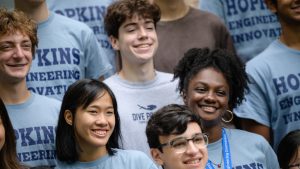
280 Residential Explore Engineering Innovation Students
JHU Homewood & Hood College campuses
-
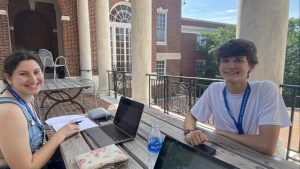
100Commuting Explore Engineering Innovation Students
JHU-APL; JHU Homewood; Hood College
-

212Online Explore Engineering Innovation Students
-
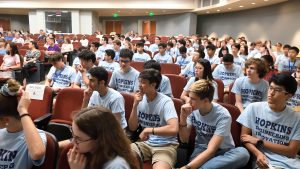
236International Explore Engineering Innovation Students
-
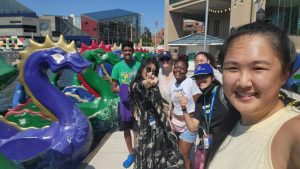
592Total Explore Engineering Innovation Students
In-Person and Online
-

114Total Biomedical Engineering Innovation Students Online
-

37International Biomedical Engineering Innovation Students
-

91 Residential & Commuter Sustainable Energy Engineering Students
JHU Homewood & Hood College campuses